My introduction to photography came at one of the lowest points in my life. Everything had been taken from me. My body, mind, career, my sense of self was taken over by chronic pain. A condition called Complex Regional Pain Syndrome (CRPS) had taken almost everything from me. I was living with constant extremely high levels of pain and loss of use of my hand for years. I didn’t really see a future and didn’t want to. Sadly, I had pretty much given up on life and was just going through the motions.
One day between the constant doctors appointments I walked into the Leica gallery Los Angeles and met Paris Chong. She treated me like I still had something ahead of me and inspired me to pick up a still camera. Invited me to meet the showing photographers and to events. She became someone who motivated me to keep my photography going and fully supported my creative adventure. No matter how strange it could get.
Photography didn’t give me my old life back, but it gave me a way to build a new one. It gave me purpose, strength, curiosity, and a reason to keep moving forward. The building blocks to what I am now and will become.
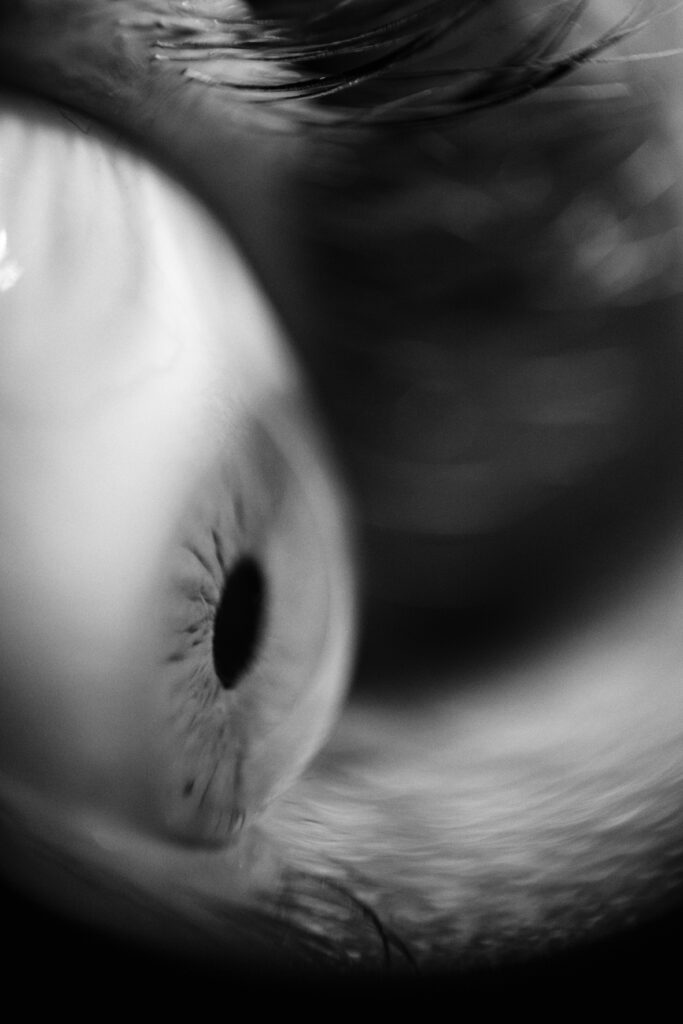
I always struggle to explain my images, because they’re really just how I feel, sometimes the meaning of an image can change with me overtime. I imagine if I could communicate it better I probably wouldn’t capture it. I think that is something very special to photography.
My work is expression based, and once someone else looks at my photographs, they are no longer mine.
The therapeutic value of photography, for me, doesn’t come from whether or not the viewer understands what I’m trying to convey in my work. I welcome people finding their own meaning in my images. I enjoy hearing what they see, including things I didn’t notice myself.
It’s a difficult thing to manage the pain I experience. Especially with photography and printmaking – both are very physical and can be laborious. I don’t think I manage the pain well, and it is what it is. No getting around it, just through it – and trying not to over do anything. I usually take my body too far and regret it later. I am physically getting worse but there is no time to give the pain in my hands and legs much weight over me. My process is somewhat masochistic as what I have to go through for the potential reward.
This means,I do have many nights laying in bed crying in pain from the consequence of my actions. but at the same time, I get to stare at what I created, the stories racing through my head living in it. Thinking, why this looks like a feeling, and not thinking about the pain. That can emotionally and physically calm me.
This is the moment that makes everything worth it. Seeing something visually new but emotionally familiar to me. If it’s a finished print, there is also the feeling of great accomplishment.
I think every image is an internal landscape in some way. The way we compose and see the world is shaped by everything we’ve experienced, whether we’re aware of it or not. It’s all a reaction both conscious and subconscious.
I’m most interested in images that don’t visually feel familiar to me, but still connect to something internal. When a photograph gets close to that, it’s like a Rorschach test. What’s visually there isn’t really the meaning, it’s what it opens up. It gives space to explore something personal, something that doesn’t need to be fully explained, it might just want to be felt. Similar to when I hear a song that pulls my emotions so I keep it on repeat.
***
For me, the camera actually does the opposite of asking me to be present. Because of chronic pain, I’m already very present in my body, and at times slowed down by the depression that comes with it. But when I pick up the camera, something shifts. I get a break from that. I get to step outside of it, even if just for a moment. It breaks the repetition in my mind and lets me move freely with what’s in front of me. I’m not really interested in capturing physical reality, people or things. I’m drawn to something in between. It almost feels like a trance. The panic quiets. I’m not really feeling pain or even pleasure, just a kind of stillness to mentally float in. Letting go, leaving my flow to let curiosity steer me in a direction where I can hopefully find something unpredictable. Where otherwise I would be thrashing to keep my head above water trying to control and overcome. In that space, something opens up. I’m not overly thinking about composing, I’m letting feeling and chance guide me. The image becomes something I receive, not something I force.
And for those moments, I’m not stuck in my body, I’m part of something else.
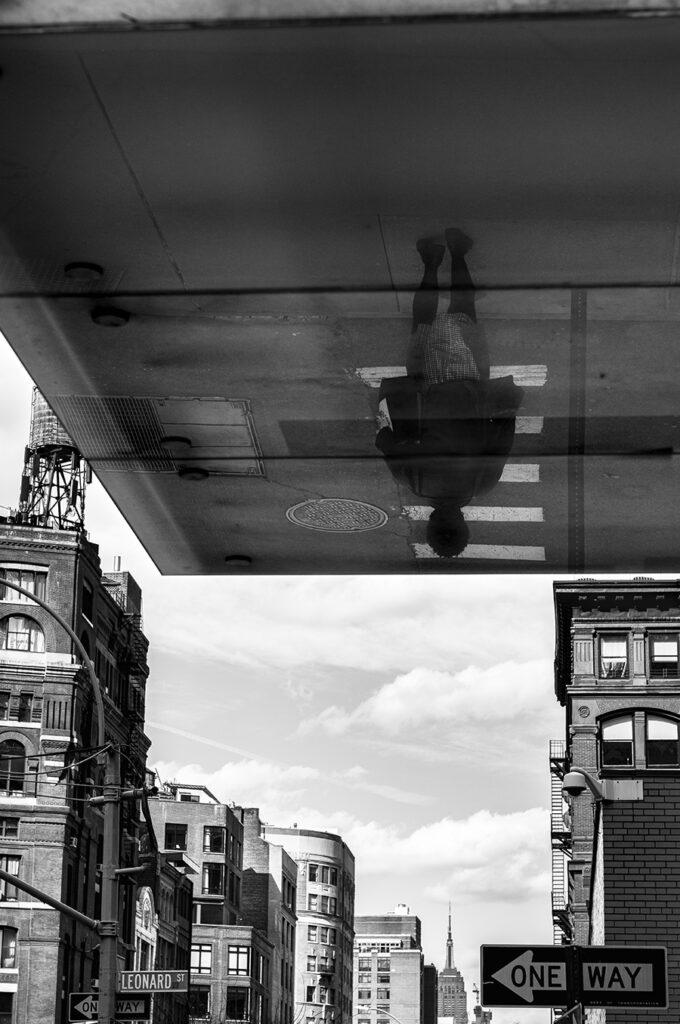
So many of my images hold that for me, it’s hard to pick just one. But there is only one I keep hanging in my home.
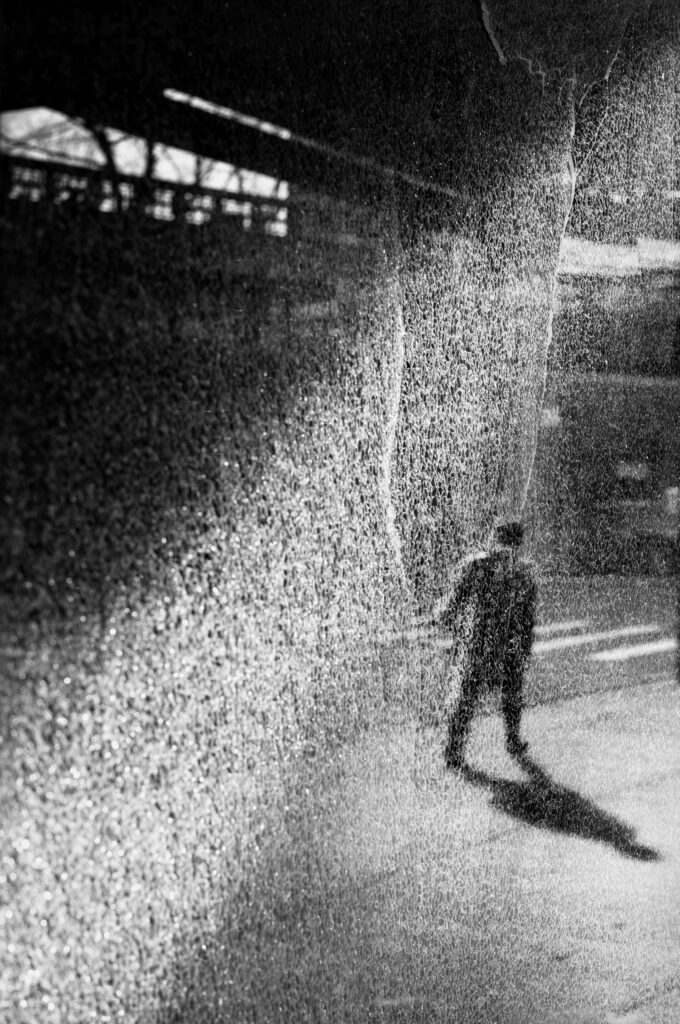
I created it in New York. I was at an event and felt completely out of place. Being around all these photographers, I started comparing myself and having social anxiety and it got heavy fast. I struggle in groups as they are very emotionally taxing
I had to leave. I was walking around the block, and my mind was spiraling, telling me I wasn’t a photographer, that I didn’t belong, that I should just quit. That I’m an imposter and don’t belong. Who would even want to talk to me, I have nothing to offer. I’m nothing like everyone else, they must hate me. I should go home, give up, I’m so dumb for even thinking I could do something. I’ll always be nothing.
Then I came across this broken window. Light was moving through it, refracting, catching reflections of people passing by. I got lost in it. The voices slowly stopped.
The broken glass felt like how fragile everything was for me at that moment, like everything I was trying to build could crash and fall apart at any second. But the light moving through it was the part I needed to see. That even in something broken, there’s still something happening, still something alive, light flowing through and eliminating the cracks. The figured silhouette walks with a heaviness and weight that I was feeling in that moment releasing the weight I was feeling.
I don’t need to fit in, I just have to keep a camera in my hand and stay open to receive an image and be me.
***
Printmaking is just as important to me as capturing the image. If I’m shooting digital, it doesn’t really feel real until it’s printed. Looking at an image on a screen doesn’t give me much connection. With processes like photogravure and platinum palladium printing, the image isn’t just on the surface, it’s inside the fibers of the paper. That changes everything for me. It becomes something physical, something I can hold.
It’s also one of the most therapeutic parts of the process. To look at a finished print and see that emotion or experience no longer trapped inside of me, it can live in the paper now. And honestly, it’s something I wish more people could experience, holding an image instead of just seeing it on a screen, on the phone we’re conditioned to look for a few seconds and move on. No time to digest and absorb an image on a phone.
A print makes me stay. It makes me question, it’s physically there and permanently exists if I don’t destroy it. It can feel good to tear up a miss print or a print if part of the process.
***
I think what doesn’t get talked about enough is the emotional side of chronic pain. The emotional weight and psychological toll constant pain can inflict, it’s often harder than the physical side but hidden away. With chronic pain or I imagine any other chronic condition, I get so good at masking the pain while trying to figure it out I ignored the mental health side. Not realizing treating my mental health would be the hidden piece of the puzzle to living a better quality of life.
I have gone through phases of wanting to show what I created and wanting to hold everything in. I have discovered I’m happier keeping it to myself, probably because I have social anxiety and I’m pretty hard on myself, but showing images can potentially spark a conversation or help someone open up. It also challenges myself stepping out of my boundaries and safety zone. That’s another gratifying part of this process. Putting the print on the wall to no longer be mine can be very powerful. I’m happy if someone looks at my images and think they could do it better or need to try to explore themselves too. But most of all above anything that could happen is someone to see my images and feel less alone. Chronic conditions are very isolating.
Photography has been a stepping stone. It’s led me into so many places I never imagined I would be. For starters it’s given me confidence to live and push my boundaries. Giving me something to look forward to in the future. It’s always there and somehow always new. There is never a time there is nothing to take a picture of.
The camera has given me access to life again. Not the life I once had, but the confidence to build something new. It gave me purpose at a time when I didn’t feel like I had something to be here for.
It’s also helped me understand myself better, what I’m going through, what I’m carrying, and given me a way to process and accept some really difficult personal things.
It’s become a kind of translator between my internal and external worlds, helping me take what I’m feeling and give it form outside of myself.
– Terry La Rue